Sunday, July 2, 2017

Climbing Mt. Erie

"On a clear day, you can see forever."  Sounds like the song or the movie doesn't it?

Well, in Anacortes (Washington) if you choose to drive up to the summit of Mt. Erie, and it happens to be a clear day, indeed you can see forever.  This was my first trip up the mountain, and we picked a fine and very clear day for this adventure.
The road is unpaved and rather narrow as it climbs through a thick forest with trails leading off into the trees for the more adventurous sort (and definitely those more physically fit than we are at this stage of our lives.)  However steadfastly I attempt to stave it off though, the longing to trek that lessor traveled path still has its draw.  In my youth I would have tackled those side trails without hesitation.
The reward of arriving at the top of Mt. Erie, no matter how one achieves the summit, is a 180-degree view to the south over Deception Pass, Whidbey Island and the Skagit Valley reaching to Mount Rainier, which is today visible in the distance on the horizon.  Above us, a sliver of the moon is visible even in the full light of this sunny afternoon.  From a viewpoint protected by a sturdy steel railing, the rocky ledge drops precipitously in front of us, and only the bravest of souls ventures beyond the railing to edge of the rocks.  That is not even an option for us, ensconced safely behind our steel boundary.  We read the warning sign about a young man that fell to his death from these same rocks.
The draw of height and a view must be a part of every human's genes.  One can easily imagine the earliest inhabitants of this region standing in the same position on this mountain in wonder of the world spread out below them.  How far did their journeys to the horizon reach?  Certainly not as far as our journeys together over the last ten years.  I suspect instead they gathered in the view of stars and the moon on midnight vigils from this vantage, dreaming the same hopes and aspirations for their lives as do we.

A view of this expanse, makes one realize how small we are in the overall scheme of things, and how fleeting our time in this wondrous world will be.

After our adventure on this day, we wandered back down into Anacortes for a fish and chip dinner at Bob's Chowder Bar.  Awesome!  And the best we've had in a long time.
 

Friday, June 30, 2017

Friday Night Date

Jim and I decided to hit the road and take a drive to Edison west of Mount Vernon for a Friday night date.  In the process, we stopped in at a great bakery, devoured a burger with a dark ale, and then drove around Samish Island-a first time for either of us.  The evening was glorious with blue sky, wispy clouds and a cool breeze.  Even Mt. Baker made a showing with its peak wrapped in clouds.
When we got out of our car in the little burg called Edison, you could smell the bread.  In spite of the draw toward Longhorn Saloon, we could not resist purchasing a loaf of bread first from Breadfarm to take home.  They were making dough on a huge table beyond the counter as the clerk handed over our freshly sliced loaf making it difficult to walk away without any of the other delectables displayed on the sales counter.  It is definitely a must visit place in the future.


The saloon's outdoor patio overlooks a slough in the rear of the building and seems to be favored by bikers.  Its picnic tables were filled to capacity.  We opted for inside and a large booth for our meal-a Longhorn Burger.  It was delicious with all of the mandatory toppings and served with a good measure of curly fries.  Add an ale, damn the diet, and we were in food heaven.


Across the street from us, a building with a store called the Lucky Dumpster had the following saying painted on an exterior wall, "Anyone who isn't CONFUSED really doesn't UNDERSTAND the situation." and a window displaying whimsical fish.  It is a purveyor of pottery, jewelry, T-shirts, and a variety of interesting ceramic creatures, among other things we discovered after our meal.  With the door wide open, there was not a clerk in sight?  So we wandered through briefly and then got on our way.

Following the coast of Samish Bay, we drove out to Samish Island past houses of all descriptions that must be summer homes to many and year round homes to others.  There's a camp at the end of the road and one chapel and that's it for any sort of enterprise.  The views were spectacular in all directions.


We ended the day at home with a walk and a movie, "Somewhere in Time" with Christopher Reeves.  It was an awesome evening.

Friday, May 26, 2017

Washington State's Stonehenge


High on a hill overlooking the Columbia River sits a replica of Great Britain's Stonehenge.  In completed formation (unlike that of the stone remnants of Great Britain's historical site), this monument was built of concrete with every pillar and crossbeam in place.  It is orientated in exactly the same astronomical position as that utilized by the original, ancient builders half a world away to align an altar stone with the rising sun of the summer solstice-every June twenty-first.

Dedicating the site of this new monument on July 4, 1918, Samuel Hill, a Quaker, began to build his "Stonehenge" to commemorate and honor the dead of World War I.  Erroneously believing that the original Stonehenge was a place used for sacrifice, Hill built his monument as a reminder to people that men were still being sacrificed to the god of war.  It was completed on May 30, 1929, two years before Samuel Hill passed away.  Originally built in the center of a town called Maryhill, it currently stands alone on a hill amid a meadow devoid of any buildings after surviving a fire that completely burned down the former town.

Nearly 100 years old, now the monument is showing the tiniest traces of wear along its edges.  Maybe a thousand years from now it will more closely resemble the rough edged rocks of its counterpart, but in the meantime its massive construction inspires awe as it towers over our heads.  The view is magnificent.  In one direction, white capped Mount Hood gleams in the sun in the distance across a meadow, while closer below us tugs ply barges along the Columbia River.  The rolling hills around the monument give testimony to the dryness of this area's climate with few trees and miles of undulating grasses that eventually give way to barren hills.
The visitors are sparse, but steadily coming and going from this low-key tourist attraction.  Names of soldiers from Klickitat County who died in World War I a hundred years ago, appear on plaques placed around the monument on each pillar-memorialized forever.  It is a solemn place if one focuses on the implications of war, but the beauty of the view and the perpetual motion of the river are soothing.  This would be a nice place to be remembered at for all of eternity.  I am thankful that Samuel Hill felt the same way a hundred years ago.  I am glad I have added this adventure to my repertoire.


Cascade Locks, Oregon

Just steps from the Columbia River, Cascade Locks, Oregon, is great for an overnight stay.  After visiting Multnomah Falls, we spent the night at the Best Western there on SW WaNaPa Street, preceded by a dinner of hand-thrown pizza and a dark ale at the Cascade Locks Ale House half a block down on the same street.  The pizza was delicious, the ale refreshing, and the hotel a pleasure with its impeccable staff, meticulous maintenance and thoughtful amenities.


The city took its name from a set of locks built there in the late 1800s.  Completed in 1896, the locks improved navigation on the river past the Cascades Rapids, operating until 1938 when they were submerged by the Bonneville Lock and Dam four miles downstream.  Today a park exists on the site with a campground, restaurant and marina with a fabulous bronze statue of Sacagawea and Seaman, a native woman and dog accompanying the Lewis and Clark Expedition.

Ninety years earlier, for two days beginning October 30, 1805, Lewis and Clark camped near this town and explored the route they would attempt through the "Great Shute" (Cascades Rapids) in the Columbia River.  Today, inundated by the lake formed behind the Bonneville Dam, the rapids no longer exist nor pose a threat for travelers or ships maneuvering through this portion of the Columbia River.
After a complimentary breakfast of huge proportions, like Lewis and Clark, we were on our way.  But we traveled in the opposite direction, up river, toward another adventure-Washington's Stonehenge...
  

Thursday, May 25, 2017

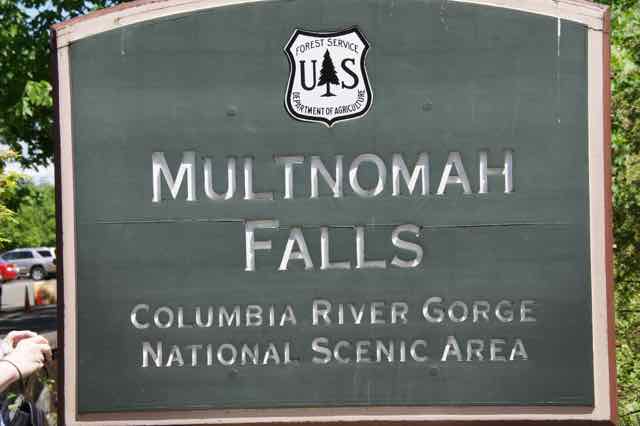
Multnomah Falls, Oregon


Multnomah Falls is a spectacular two tier waterfall east of Portland, Oregon, and the most visited natural recreation site in the Pacific Northwest.  Over two million visitors a year travel to the site located in the heart of the Columbia River Gorge National Scenic Area, and we were one of those explorers this spring.


Created by floods occurring during the Ice Age, the falls, the Columbia River, and the gorge are spectacular examples of the power of water.  The gorge was carved out by repeated, massive floods occurring from breaks in melting ice dams upstream whenever conditions warmed sufficiently during the Ice Age.  It is easy to wonder what the surroundings must have been like on the days when a wall of water came crashing down through this area creating the riverbed and cliffs that make up the gorge of today.  The sound of it must have been horrific, like the ending of the world.

Driving easterly, we sight smaller waterfalls cascading over the edges of cliffs rising sharply to the south of Interstate-84, as the highway follows the curves of the adjacent Columbia River to its north. At Exit #31 on the highway, the off ramp leads directly into the parking lot for the visitor's center at Multnomah Falls, with room for parking vehicles of just about any size.
The spectacular flow of water over the cliff rising sharply above the visitor's center drew us quickly up a small climb along a paved path to the visitor's viewing area for the falls.  Gazing upward at the power and beauty of the falls created by this spring's abundant runoff, the cascading water was mesmerizing as wisps of mist swirled around us.

Then the adventurer in our genes took over.  We climbed the two-tenths of a mile walk up to the bridge overlooking the pool of water at the base of the upper tier of the falls.  An easy climb through the woods, this vantage point revealed a superb bird's eye view of the visitor's deck below at the base of the second tier of the falls, as well as a close-up view of the upper falls.

Braver souls than us continued on past this bridge for the mile hike along a serpentine trail up to the summit of the falls.  We were satisfied to return to the visitor's center to peruse through the multitude of interesting publications and displays describing the falls and their history, before indulging in an ice cream cone!

Sunday, May 21, 2017

The Wonder of Snoqualmie Falls and the Railroad

Snoqualmie Falls has always drawn people to the brink of the precipice that surrounds them.  The water flow is huge this year after a long, cold and very wet winter.  The welcomed sun has drawn a crowd, including us on a family road trip.

From the overlook that stands seemingly level with the top of the falls, it is a sheer drop to the river below.  I am in awe of the power of the water every time I stand there-so clear you can see the very bottom of the riverbed.
I wonder what is going through the mind of our four-year-old great granddaughter as she gazes downward?  How many others her age have done the same and seared the experience into their memory forever?  I like to imagine the Native American children who stood here in this same place and listened as their parents told them the Snoqualmie Creation Story.  Here, for them, the earth was made when a fish weir was changed into the falls, and mythical creatures were transformed into their present forms of people, plants, and animals.

There are many moments of wonder along our path for a child.  The retired part from the electric plant's generator that utilizes the power of the water to generate its own electric power stands as tall as she.

We lingered here until our amazement was satisfied, then explored the gift shop of Salish Lodge for its consistent selection of wondrous items that are impossible to resist from candy and books to dishes and decor.  A passing waiter with a tray of cupcakes destined for a probable wedding reception at the Lodge reminded us it was time to eat and we left for the nearby town of Snoqualmie to sample what the Copperstone Italian Restaurant could offer.  We were happily rewarded.

The Snoqualmie Railroad Museum provided the next temptation with its 1890 depot and collection of trains.  There were train cars to explore and a depot filled with historic memorabilia to delight the child in all of us.

It was a good, and sunny day, and for that we were grateful.  Life, especially that seen through the eyes of a child, is delightful.


Saturday, May 13, 2017

Vikings, Aloe Vera and #adulting

Three articles caught my attention this week in various publications.  I love reading something that makes me think about the world around me-thinking about subjects I might otherwise have not pondered.

In the March, 2017 issue of National Geographic there is a wonderful article on the Vikings.  This is of particular interest to me because of my Norwegian/Danish heritage.  I did not realize that the Vikings started wandering because of climate change.  A volcanic eruption, coupled with a meteorite strike in A.D. 536, sent debris up into the earth's atmosphere.  That caused a cooling phase of the Northern Hemisphere for the next 14 years.  The resultant cool summers impacted the ability of Scandinavians to survive in their northern region because of their medieval, limited agricultural knowledge.  This led to the abandonment of seventy five percent of their villages, as they succumbed to both starvation and the fighting that ensued.  By A.D. 750, survivors had mastered the skill of making sleek boats with sails.  This enabled them to raid, explore and plunder Europe and Great Britain, and subsequently Greenland, Iceland and parts of northeastern Canada.  Interestingly, many took to wearing the plunder they captured as a status symbol.  Portraying the story of their conquests with neck rings, dress pins, arm bands and finger rings, they dressed in colorful clothing and painted their eyes.  They were the "Johnny Depps" of their time, according to Steve Ashby of the University of York.
"How I Grew Five Mothers" by Marc Peyser in the May, 2017 issue of Reader's Digest is a hilarious story from the magazine's "Department of Wit."  He relates how his dad's matrimonial motto of "If at first you don't succeed, tie, tie the knot again," yielded several mothers.  Marc hilariously describes each using horticultural examples, for example his "aloe vera mother who fixed boo-boos."  The story ends with the writer declaring that each of his mothers created her own maternal love area encompassing its own peculiarities.  He adds, "In spite of my father's dubious taste in wives, when it comes to moms, he sure knew how to pick 'em."  I had to laugh while reading this little essay.  Within my own life I myself have been one of those multiple "moms" over the course of several marriages.  I also gained one stepmother, her children, and their extended families because of my dad's third choice in wives.  Add to that the friends I have chosen as "family" and my world is quite full of wonderful people.  And all because, like so many families in today's world, many members of mine (and I) "tied the knot again and again."  So here's to blended families-a true blessing in disguise.
Finally, there was the May 6th "Saturday Essay" in the Wall Street Journal describing the new hashtag:  #adulting which denotes being engaged in adult behaviors, rather than embracing today's drift toward perpetual adolescence.  Written by Ben Sasse, the junior U.S. senator from Nebraska, the essay is adapted from his new book, "The Vanishing American Adult:  Our Coming-of-Age-Crisis and How to Rebuild a Culture of Self-Reliance", which will be published on May 16th by St. Martin's Press.  I found the essay so thought provoking, that I intend to buy his book!  One of my #adulting takeaways: to join "The Century Club"-by meeting a challenge to read 100 books in a year.  Here's a link to the article-but you do need a subscription to the Wall Street Journal.